Tuesday, January 29, 2013

native foods

Taken from Native foods from Stone circle farm .com

Native Foods

By Rita Bober
When I began adding native plants, shrubs and trees to our homestead and identifying edible and medicinal plants while studying herbalism, I wondered what Native People from the Midwest ate when they were the sole inhabitants of this region. This article will share some of my findings on Native food.
The Anishinabe People first lived on the shores of the "Great Salt Water in the East." Prophets came to the People and told them that to survive, they must move west. As they traveled west, they would know where to settle when they found "the food that grows on water." So when they reached the Great Lakes area, they did find "the food that grows on water" — Mano'min or wild rice1. Since that time, wild rice has been one of the main foods of the Anishinabe People especially the Ojibway.
Another important food of this area is the sap from Ninautig, the Maple tree. At one time, all the maple syrup in North America was produced by Native people. Sap was also gathered from birch, poplar, and basswood trees.
Native people of the Great Lakes area were hunters and gatherers. They survived on what they could find in the woods and lakes around them. They ate according to the seasons. To the People, all this was given to them by the Great Spirit and their lifestyle reflected a gratitude for all of life's bounty.
Their diet included meat or fish, when it was available. This was supplemented with greens, herbs, berries, and roots. In an unpublished paper, Grandmother Keewaydinoquay2, an Ojibway Elder, listed the unique foods that had been used in earlier times. Meat included: venison, porcupine, goose, wild turkey, partridge, quail, pigeon, buffalo, elk, bear, rabbit, squirrel, beaver, groundhog, muskrat, raccoon, turtle, bull frogs, and ducks.
Fish included: trout, smelt, whitefish, pickerel, bass, fish eggs, salmon, catfish, perch, carp, muskie, pike and more. Grandmother had been raised in a traditional Native family but was also trained in the Western tradition as an ethno-botanist and was familiar with many local plants.
She stated that the People gathered a variety of foods from the woods, fields, and lakes to supplement their meals. These included: cattails, wild leeks and onions, wild greens, mushrooms, rose hips, sumac, water lily, wild cranberries, cactus, wild cucumber, nettles, serviceberry, raspberries, wild crabapples, elderberries, blackberries, blueberries, wild cherry as well as nuts — acorn, chestnuts, walnuts, hazelnuts and hickory.
Along with meat, wild rice, maple syrup and eggs gathered from bird nests, they enjoyed a great variety of foods. Native people did not have dairy products such as butter, milk, or cream but they did have a variety of fats including animal fats, particularly bear, and nut oils from acorns, beechnuts, butternuts, hazelnuts, sunflower seeds, and black walnuts. Traditional calcium and mineral sources included eating whole fish, making bone soup or broths and eating greens. Babies were breast fed for several years.
Frances Densmore, an ethnologist, detailed the uses of nearly 200 plants in her book about the Chippewa Indians (another word for Ojibway) How Indians Use Wild Plants for Food, Medicine & Crafts. Along with the items listed above, Densmore included: juneberry, bearberry, wild ginger, common milkweed, aster, creeping snowberry, wild bean or hog peanut, wintergreen, Jerusalem artichoke, mountain mint, Labrador tea, bugleweed, chokecherry, bur oak acorns, red and wild currant, arrowhead, bulrush, basswood bark, hemlock leaves, and wild grapes.
Carolyn Raine of Seneca heritage wrote about historical references to Native foods in her book, A Woodland Feast: Native American Foodways of the 17th & 18th Centuries. Her book is based on primary source documentation, from over one hundred original 17th and 18th century journals, captivity narratives, and ethno-botanical research.
Additional foods to consider include: skunk, snake, otter, tree bark, rendered tallow, sturgeon, gull's eggs, swans, organ meats and blood, broths of dried frogs and beaver tails. The general rule for any meal was to cook some meat in a large pot and whatever greens, roots, nuts or berries were in season. Plants and animals were honored and all parts were used either for food, clothing or utensils. Raine describes methods of food preparation and cooking including roasting, boiling, drying, as well as making soups and stews. Today, many Native foods are still available. You can gather meat by hunting and fishing or you can raise buffalo, turkey, rabbits, ducks, and quail yourself. Many of the green plants Natives used are still growing today. You can grow many of these plants in your own yard. It is commonly thought that edible plants like lamb's quarters, purslane, chickweed, red clover, and sheep's sorrel are native but they were brought here by European settlers.
Native people of the Midwest acquired seeds of pumpkin, corn, beans and squash from Mexico and South America which they often grew in round gardens. Europeans referred to "corn" as grain while Natives called "corn" maize. Maize came in many varieties. They included a soft variety known as bread maize, an 8-rowed flint, dent, and even popcorn. They came in many colors: white, yellow, red, black, purple or blue, and calico or multi-colored. The Grandmothers had many ways to cook or use maize. It was boiled, roasted, dried, parched, pounded into meal, and boiled with wood ashes to make hominy.
Natives used maize or hominy, fresh or dried, for bread. Pounded meal was mixed with water, and this was made into small cakes that were either baked in hot ashes (ash cakes) or dropped into boiling water, soup or stew to make boiled maize bread or dumplings.
Many varieties of beans were also brought up from the south. Both shelled and edible pod varieties such as cranberry, navy, arrow, "snap" or "string" as well as several types of kidney beans were grown. The beans were usually boiled with meat or vegetables and were also mixed with cornmeal to make cakes and dumplings. They were often dried so they could be stored and used during the winter.
Different varieties of squash and pumpkins were also grown in the gardens. The Grandmothers would boil, bake or roast them near the fire, and dried them for use in winter. Although maize (corn), beans, and squash were not native to this area, they were grown here before European explorers arrived.
If you are interested in growing some of the foods that the Native People ate, first check around your area. You will often find sites that have black elderberry and blackberry bushes. Trees to look for include sugar maple, black walnut, wild black cherry, mulberry, and white oak. Each of these has "a gift" to share with you. If you live by water, you may find cattails and water lilies. In the woods, violets, mature Mayapples, ramps (wild leeks); and in your fields, there may be Jerusalem artichokes and milkweed plants. There are even plants that grow in our native prairie's that are edible. For example, you can make tea with the leaves from monarda, mountain mint, and New Jersey tea.
Check out the resources below for more ideas. Many of the fruits and greens that we grow in our gardens today are variations of those that were used by Indigenous people. Eating things that grow in the wild, could save you money. Just make sure they have not been sprayed or are close to the road where salt and car emissions have polluted them.
Native seeds for maize, dry beans and squashes can be found through Seed Savers Exchange. There are too many people today for all of us to eat "wild" food all the time, so growing some of them in our "wild" places or in our gardens is a great idea.
Native People lived for years off what they harvested in the wild and were very strong and healthy. Perhaps it is time for us to consider including "native wild foods" into our everyday cuisine. Be sure to thank the plant for its gift and save some for the next generation.

Wednesday, January 2, 2013

I'm officially addicted, I knew it !!

Yup, I thought one tree order would do it, nope I was wrong.

I just sent out a second tree/plant order, yes I'll admit I'm addicted to trees.

I saw a great buy on some more peach trees (yes I had already ordered two, and Elberta and a Reliance), but these were some I had before the fire, a Hale Haven and a Red Haven, so I couldn't resist. They also had a grab bag of 25 strawberry plants, which I needed and a great buy on Hardy Kiwi so I ordered 1 male and 4 female of those too.

Yes I know, I'm bad.

But when there is still room to plant perennial fruits and veggies what is a gal to do !

Tuesday, January 1, 2013

Thinking back over the hurricanes...sustainability thoughts

When the superstorm Hurricane Sandy hit the East coast it really made a mess, some people still have no homes and no electricity ..months later. So now the subject comes up of sustainability.

Sure we all consume things year around that we wouldn't have if we were hit by a similar tragedy..and we could do without them quite eaisly should tragedy strike, like this computer, my paid t v, cell phones, etc.

But I'm thinking more about actually being able to survive, live, without the government stepping in to do things for us, no FEMA, Red Cross, Salvation Army, etc.

I'm thinking that this year I would like to become a little more able to sustain LIFE should something serious happen here. No not preppers or survivalists, but just able to sustain LIFE.

The things we NEED (not want) are shelter, food, heat in Michigan, water and in some cases medical equipment or supplies.

Shelter is a given as long as our home is intact (and we do have good insurance as we did lose a home to a housefire in 2002). We also have camping equipment and tents if we had to use them and live next door to our son so if one of us lost a home the other could provide.

Heat here in Michigan is very important. We have a new outdoor wood boiler and an indoor wood fired fireplace, both have electric fans and outdoor one has electric pump. The indoor wood fireplace would heat the house somewhat without the fan, but much better with the fan. However, we purchased a propane generator a couple years ago and when we had a prolonged power outage last March it was quite useful in running fans, refrigeration, pumps, etc. We have about a year's supply of propane at any time as well as a couple small back up tanks and our propane barbeque grill and propane camp stove. We have a large woodshed and always have about 2 years of firewood put up in the fall ahead, so we could get along for a while with that and have chainsaws so we can cut some as long as there is fuel for them.

I also have durable medical equipment that we use with our generator when we have to, when power goes out.

Water, well as I said we have the generator that will move the pumps, but we also have access to a flowing well in an emergency and creeks within walking distance of our house as well, so water isn't too much of a problem, more an inconvenience if we had to haul it.

Food, this is an area where I'm falling short. I have planted serious food forest gardens, but because we lost most of them in our housefire of 2002 ..many of our fruit trees and nut trees are very young. This year we are hoping to have a lot more of a harvest off of our fruit and nut trees and our berry bushes and grapevines, but last year was a disaster with our frosts and droughts. I really need to work on the food side of sustainability here. I have a canner and a small pressure cooker and water bath canner, and supplies, but I would love to buy a NEW canner this year and a lot more supplies. I also have a dehydrater and drying racks as well, so drying is something I do quite a bit of each year. I have 2 separate freezers from my refrigerator, but keeping those going with the generator would be a tad more difficult if it was prolonged need..but if it was I could remove the food and can it, cook it or dry it before running out of propane.

I have planted a lot of foods that can easily be eaten that are perennial in our area, and we have a lot of forage options that non foragers wouldn't recognize as food, like edible tree leaves and flower garden plant roots and flowers, etc..so this knowledge would save our lives in a food shortage situation.

Meat, well that is another situation that might be a problem as at this time we have no domestice animals other than 2 cats (who would bring us songbirds and mice, yuk)..but we have a lot of wildlife in our area which we do feed and we have ability to hunt and process those. I hope to get myself a flock of chickens in the spring and get a chicken house and run built, and am also thinking of putting a few ducks on my pond. This year we are trying a "bubbler" to keep the pond open in the winter, which is working, but does require electricity to run. This said, we can plant fish in the pond with the bubbler going that would be edible as well..so that is a plan for spring, stocking the pond with fish.

There are a lot of deer and rabbits and squirrels and other wildlife that is edible in our area and even game birds like turkey, pheasant, doves, etc. So as long as we are able to harvest them we will have meat but I do believe this is an area I need to plan better for in the future.

Fuel for vehicles and tractor is one thing that we might fall short of also, but we have bicycles and I enjoy walking, so access to transportation in the nice weather isn't a problem, I don't ski so some snowshoes might be a good investment in the future as well.

I'm sure that additions of some solar cells with batteries or a wind generator would be a good investment, which we have been considering but haven't had the $ to buy the equipment yet, and we are planning on putting in an outside access water well, hopefully will hit a flowing well, in the next two years which we  believe would be a good investment for our future.

I hope this has given you some ideas of what you might need to do if a Hurricane Sandy, or earthquake, or tornado, or housefire, or SHTF episode happens, or even for a zombi apocolypse hits..at least it has gotten me thinking a little more about the future in 2013..Happy New Year

Sunday, December 30, 2012

fruiting on my shiitake log in Decemnber (Mich)???

I went for a walk in my food forests this weekend, and I found fruit on one of my shiitake logs yesterday. Went out and snapped some photos today. The fruit IS coming out around the shiitake dowels I put in the log in the spring, but it isn't shiitake..probably some stupid foreigner got ahold..hope the shiitake is still growing in there..but this is only one of several logs and others show no growth yet.


Unfortunately this is NOT shiitake fruit..not sure what it is or if it is edible.
Maybe I'll send the photos to Paul Stament and find out if he recognizes it ..and really should anything be growing in 34 degree weather in Michigan in December??

End of 2012/ looking forward to 2013

Well here we are at the end of 2012. The drought seems to be over as we have had a wet winter, there is snow on the ground now.
BRRRRRRRRRRRRRR...This photo was taken from my dining room window toward the back gardens.

Well it is time for dreaming and planning now..can't do much outside other than shovel.

This week I sent out an order for 4 new fruit trees and a bunch of open pollinated garden seeds. We had a horrible drought with extreme heat last year, quite unusual for Michigan and so we lost a lot of plants, seeds and had damage to some of our trees. Also there was a very late hard freeze for a few days that destroyed all the fruit tree buds in May and June, so we had very little fruit crop for 2012.

The new fruit trees that I ordered were 2 standard peach trees, one a Reliance and one an Elberta, both freestone and very hardy for our area. I ordered another sweet cherry, Stella, this one is supposed to be "self fruitful" and it is standard size. The Windsor that I got last year had no real root and died, so it is to be replaced this spring, it is also a sweet cherry and standard, so there will be two new sweet cherries planted in 2013.

The large apple tree in the photo above on the left, is a volunteer from an apple core that had been thrown out many years ago. We believe the apple that began it was a Northern spy, probably crossed with whatever was in the area. It has medium size apples that come on quite late and are good keepers and are very tasty, but do have a bit of a bug problem from time to time. The 4th tree I ordered is a Nova Spy. It should be a good pollinator for this old tree, it is also a standard so we'll put them fairly close to each other.

In my food forests we have some trees reaching bearing stage at last. We got a really good first crop off of our 6 hazelnuts in 2012. They were small but very tasty (now I need to get a really good hazelnut nutcracker). No crop on any of the other nut trees in 2012, maybe next year, they are all still quite small. I even put in a few new nut tree babies this past year. So now we have black walnut, butternut, carpathian walnut, heartnut, sweet chestnut, hazelnut, Halls hardy almond, hickory nut that we hope soon will grow large enough to bear.

We had only 2 pears that formed on one of our pear trees this past year and one fell off, so we had one to eat, and it was heavenly  !! Hopefully we won't have those late freezes this year and we'll get a nice crop of pears. I have several kinds of trees and even have some roots that survived from trees where grafts died that I'm leaving in (I have the room for whatever comes of them). The other fruit trees didn't fare even as well as the pears, as we had no fruit on any of them except one fruit on the baby Medlar that I put in this year. Most of them are at bearing age so we are quite hopeful for 2013.

We did have a few lovely grapes on some of our newer grape vines this year, they were delicious.

We had the best crops ever of our asparagus and rhubarb this year, but the drought did a lot of damage on the annuals especially.

We had some good black raspberries, but they didn't last as long as they should have and the blueberries and other berries were pretty sad.

With all the moisture we have gotten so far this Winter, I am very hopeful that we'll have a better crop year, also I hope to be able to get some more mulching materials this year (our truck is still dead but we were given a lovely mini van which I can use to haul stuff with..woo hoo).

My old eyes are getting worse so I'm going to try a few things this year, one I have tried before and others are new to me. In the past I have planted PURPLE green beans and YELLOW ones too..well this year I'm doing that again and planting them up on a higher raised hugel bed. Hopefully  this will make them easier for me to pick (and see)..the purple ones turn green when cooked.

I also found a white cucumber, yup white, so I'm planting those this year also, green on green is very difficult for my eyes to see so that is the plan.

Well as I said, the tree and seed order went in. Henry Fields has a great sale going and I got some really great prices..so I couldn't resist. I am sure I'll order some more seeds (just can't help myself) and  who knows, might go crazy and get more fruit trees, there is still some open ground available.

Anyway, Happy New Year to all of you and hope your 2013 is bountiful.

Tuesday, October 23, 2012

some of our fall mushrooms ..poison and non poison

Read now
Close

Amanita muscaria


From Wikipedia, the free encyclopedia


Jump to: navigation, search

Amanita muscaria
A. muscaria
showing various growth stages
Scientific classification e
Kingdom:Fungi
Phylum:Basidiomycota
Class:Agaricomycetes
Order:Agaricales
Family:Amanitaceae
Genus:Amanita
Species:A. muscaria
Binomial name
Amanita muscaria
(L.:Fr.) Lam.
Amanita muscaria
View the Mycomorphbox template that generates the following list
Mycological characteristics
gills on hymenium
cap is flat
or convex
hymenium is free
stipe has a ring and volva
spore print is white
ecology is mycorrhizal
edibility: poisonous
or psychoactive
Amanita muscaria, commonly known as the fly agaric (play /ˈæɡərɪk/) or fly amanita (play /ˌæməˈnaɪtə/), is a poisonous and psychoactive basidiomycete fungus, one of many in the genus Amanita. Native throughout the temperate and boreal regions of the Northern Hemisphere, Amanita muscaria has been unintentionally introduced to many countries in the southern hemisphere, generally as a symbiont with pine plantations, and is now a true cosmopolitan species. It associates with various deciduous and coniferous trees. The quintessential toadstool, it is a large white-gilled, white-spotted, usually deep red mushroom, one of the most recognizable and widely encountered in popular culture. Several subspecies, with differing cap colour, have been recognised to date, including the brown regalis (considered a separate species), the yellow-orange flavivolvata, guessowii, formosa, and the pinkish persicina. Genetic studies published in 2006 and 2008 show several sharply delineated clades that may represent separate species.
Although it is generally considered poisonous, deaths from its consumption are extremely rare, and it is eaten as a food in parts of Europe, Asia, and North America after parboiling. Amanita muscaria is noted for its hallucinogenic properties, with its main psychoactive constituent being the compound muscimol. It was used as an intoxicant and entheogen by the peoples of Siberia and has a religious significance in these cultures. There has been much speculation on traditional use of this mushroom as an intoxicant in places other than Siberia; however, such traditions are far less well documented. The American banker and amateur ethnomycologist R. Gordon Wasson proposed that the fly agaric


Read now
Close

Coprinopsis atramentaria


From Wikipedia, the free encyclopedia


Jump to: navigation, search

Coprinopsis atramentaria
C. atramentaria
Scientific classification
Kingdom:Fungi
Division:Basidiomycota
Class:Agaricomycetes
Order:Agaricales
Family:Psathyrellaceae
Genus:Coprinopsis
Species:C. atramentaria
Binomial name
Coprinopsis atramentaria
(Bull.) Redhead, Vilgalys & Moncalvo (2001)
Synonyms
Coprinus atramentarius
Coprinopsis atramentaria
View the Mycomorphbox template that generates the following list
Mycological characteristics
gills on hymenium
cap is ovate
hymenium is free
stipe is bare
spore print is black
ecology is saprotrophic
edibility: edible
or poisonous


THE SHAGGY MANE MUSHROOM
Scientific name: Coprinus comatus
Image - Photo of the edible Shaggy Mane mushroom (Coprinus comatus)
This Shaggy Mane mushroom's cap has begun melting into black goo.
About one-half actual size.
The Shaggy Mane mushroom (Coprinus comatus; see photo, above) is a very common, visually distinctive mushroom with a really nice flavor. The Shaggy Mane mushroom is quite popular, and is among the four mushrooms author Clyde M. Christensen listed back in 1943 as "the fool-proof four." Personally, I don't consider any edible wild mushroom to be fool-proof—the fools Christensen had met apparently weren't of the same calibre as some of the ones I have met!

The Shaggy Mane mushroom's most salient hallmarks are the bulletlike shape of its cap, which is reliably covered with delicate white scales—one cannot handle the Shaggy Mane mushroom without getting bits of those white scales on his hands—and the fact that the mushroom's cap "melts" into an inky black goo, starting at the edge of the cap (see photo, below). Be sure that the Shaggy Mane mushroom is at least four inches or so in height with a weight of several ounces each; this will rule out much smaller, more delicate species, including some dangerous Lepiotas and several small "edibility uncertain" species of Coprinus. Though the Shaggy Mane mushroom is a gilled mushroom, its gills are very tightly packed; the beginner might not even immediately recognize them as gills. Nonetheless, it is important that the mushroom hunter checks to make sure that her specimens do have gills before cooking and eating them.

The Shaggy Mane mushroom fruits on the ground, primarily on lawns but even on bare ground—it has even been known to push up through gravelly, hard-packed soil or old pavement! Its season runs from spring through autumn (it's not unusual to find it on the same lawn in the spring and again that same fall). As with all wild foods, it is very important to avoid collecting specimens from contaminated habitats; I have seen a massive fruiting of the Shaggy Mane mushroom on a polluted industrial "brownfield."
Image - Photo of the edible Shaggy Mane mushroom (Coprinus comatus)
The entire genus Coprinus is noted for "melting" into black goo (which contains huge numbers of spores!), hence they are, as a group, commonly called "Inky Caps." If one notes the robust size and the distinctive scales of the Shaggy Mane mushroom, there's only one species (actually, it's probably a group of several different closely related species) with which it is likely to be confused by a reasonably careful person: The Scaly Inky Cap (C. variegatus = C. quadrifidus; see photo, below), which has whitish scales but lacks the Shaggy Mane mushroom's overall white color. Some people do eat C. variegatus, but I strongly advise against that, as it has been known to cause gastrointestinal symptoms for some folks and also seems to react very unpleasantly with alcohol in people who've consumed both within a period of a few days (for more information on this phenomenon, see COPRINE on the Poisonous American Mushrooms webpage).
Image - Photo of the poisonous Scaly Inky Cap mushroom (Coprinus variegatus)
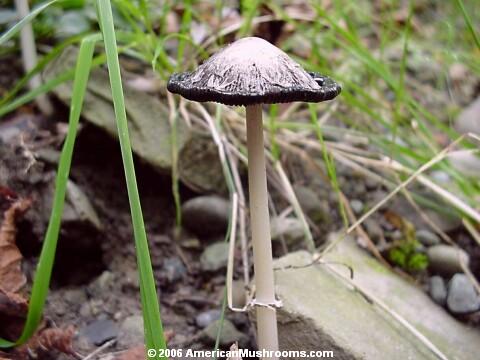
One other mushroom in genus Coprinus, the so-called "Alcohol Inky" (Coprinus atramentarius, see photo below), is also noted for its toxicity when eaten in conjunction with alcoholic beverages. It is far less likely to be mistaken for the Shaggy Mane mushroom, but the wise mushroom hunter will nevertheless be aware of it so as to prevent the possibility of adverse reactions.
Image - Photo of the poisonous Scaly Inky Cap mushroom (Coprinus variegatus)
There's a lot more information about the Shaggy Mane mushroom and other choice edible wild mushroom species
in my best-selling book, Edible Wild Mushrooms of North America.
Coprinopsis atramentaria, commonly known as the common ink cap or inky cap, is an edible (but sometimes poisonous, see below) mushroom found in Europe and North America. Previously known as Coprinus atramentarius, it is the second best known ink cap and previous member of the genus Coprinus after C. comatus. It is a widespread and common fungus found throughout the northern hemisphere. Clumps of mushrooms arise after rain from spring to autumn, commonly in urban and disturbed habitats such as vacant lots and lawns, as well as grassy areas. The grey-brown cap is initially bell-shaped before opening, after which, it flattens and disintegrates. The flesh is thin and the taste mild. It can be eaten but is poisonous when consumed with alcohol – hence another common name, tippler's ban

Thursday, September 27, 2012

Fall and new hugel bed

Well it is fall here now and we have MOST of our firewood put up. We did have a few logs go punky before we could get them cut up and stacked, so we have decided on an alternate idea for using those punky logs as well as some stumps, hard to use tree parts, branches, etc.

We are building a new baby hugelkulture bed just east of the house, very close so that we'll have at least one of our gardens close enough to run out and pick something for dinner rather than 200' away.

Joel has a crappy front lawn (our son) so we stripped off the sod for him to use in his yard, much better, and then we discovered a nice deep topsoil of rich black dirt.

In digging to see how deep that topsoil was we discovered it was likely 18" and then sand..so Joel dug all the black dirt off of the area and set it aside to redistribute the wealth on top of the bed when finished..(election terms sticking in my head this week).


After piling the soil to the side we quit for the night, and there was some water seeped in from the water table, there is also a drain sock in one corner that leads to a drain tile to a ditch, so it wouldn't ever fill completely with water.


I was standing on the deck when I took this photo, there is about 25' between the deck and the bed so it will be much closer to go and harvest produce. You can see that there is a spruce tree on the NE side of the bed and N of there is also a baby maple tree. Out in the field are baby weeping willows and other trees such as pines and maples..and north of this area is a large pond that the water drains into from this lawn area. My son's house is to the south east (right).

The next day Joel began chaining up piles of punky logs and hauling them to the hole, and stacking them in..in a matter of 2 days he got two layers and a third layer on one side which he began backfilling with some soil with sawdust and wood chips and bark in it, and then with the black dirt..you can see more dirt piled to the left of the backfilled area, that will go over the right side when we finish stacking logs in there.

The trees that I'm peering through to take the photos are 3 dwarf pear trees planted right next to the railing of my decking..the deck is the full length of the side of our house and there is a greenhouse and woodshed here as well..so we leave a drive through so we can get to the woodshed on the left.

Eventually we'll finish both sides of the bed, rake the top off even and then we'll mulch it well with compost, grass clippings and chopped fall leaves and we'll continue to add compost over the winter. We'll plant some areas with some winter wheat and other winter crops to stabilize it over the winter..and we'll plant a couple of baby peach trees either this fall or early spring on the west side (hoping the bed will help protect the peaches from late spring frosts).

All of our gardens are mixed edible food forest gardens and this one will be too when we are able to plant it, we'll use the peach trees as well as some comfrey, rhubarb, herbs and of course perennial and annual crops.

(editing) Last night Joel finished off filling the right side of the hugelbed with more logs, including some aspen cordwood and punky stuff. He finished piling on some sawdust, woodchips and bark as well as the rest of the black soil and smoothing it over some ...still have to put on the mulch but this is the fnished bed before mulch or planting.

and no, Jimmy Hoffa is NOT buried in our yard..this is reallly a hugelbed..